Crypto / CRYPT03 - CSCV 2026
A writeup on the Crypto / CRYPT03 challenge from CSCV 2026
The Challenge
CRYPT03
Description
give_to_player.zip
nc 59.153.245.196 1338
The attachment has three files: chall.py (the service), aes.py (a plain Python AES with a configurable round count) and core.c (a fast AES-NI helper). Connecting prints a banner and a small menu:
SEVENFOLD / INTEGRAL SIX
PUBLIC={"rounds": 6, "nonce": "80e5faeca1828e3c", "flag_ct": "57e00d56...", "bases": [...], "pt": "000...0", "ct": "5d3d1ede1baef0f9beb46d8ea6256283"}
1. Encrypt
2. Get structure bitmap
3. Exit
The flag is encrypted with AES-128 reduced to six rounds, in CTR mode. The banner more or less names the attack already: "integral", six rounds.
The final flag is:
CSCV2026{sevenfold_aes7r_gpu_2_rtx_5090_hehe_hihi}
The Walkthrough
What the service gives us
chall.py keeps one random key, one nonce and six random 16-byte "bases" per instance. The flag (50 bytes, so four CTR blocks) is encrypted as flag ^ AES6(nonce || counter).
Option 1 is an encryption oracle with exactly one restriction:
if len(p) != 16 or p[:8] == nonce and int.from_bytes(p[8:], 'little') < (len(flag)+15)//16:
    print('Rejected')
It refuses the four counter blocks of the flag and nothing else. The comparison is on raw bytes of a fixed length, so there is no parsing trick to slip a counter block through. The key has to be recovered.
Option 2 is the interesting one. It asks for a group (0 to 3) and a structure (0 to 5), then runs this loop in core.c:
for (uint64_t i=0;i<count;i++) {          // count = 2^32
    p[0] = (uint8_t)i;
    p[5] = (uint8_t)(i>>8);
    p[10] = (uint8_t)(i>>16);
    p[15] = (uint8_t)(i>>24);
    __m128i x = run(k, _mm_loadu_si128((const __m128i*)p));
    _mm_storeu_si128((__m128i*)c, x);
    uint32_t idx = ((uint32_t)c[loc[3]]<<24) | ((uint32_t)c[loc[2]]<<16) | ((uint32_t)c[loc[1]]<<8) | c[loc[0]];
    __atomic_fetch_xor(bits + (idx>>6), 1ULL << (idx&63), __ATOMIC_RELAXED);
}
Bytes 0, 5, 10 and 15 form the main diagonal of the AES state. The other twelve bytes come from bases[structure], and every base has b[1] = nonce[1] ^ 0xff, so a structure can never contain a counter block. All 2^32 values of the diagonal are encrypted, four ciphertext bytes are picked, and bit idx of a 2^32-bit array is flipped. What we receive is a 512 MiB parity bitmap, where bit v is set when the four chosen output bytes take the value v an odd number of times.
group picks which four ciphertext bytes are read:
group 0: c[0], c[13], c[10], c[7]
group 1: c[4], c[1],  c[14], c[11]
group 2: c[8], c[5],  c[2],  c[15]
group 3: c[12], c[9], c[6],  c[3]
Each group is one output diagonal, which after the final ShiftRows lines up with one column of the state before round 6. The first release of the attachment only had group 0. The group prompt came with an updated attachment during the CTF, and that update is what makes a full key recovery possible.
A real bitmap looks like noise:

The density is a nice sanity check. 2^32 inputs land in 2^32 buckets, so each bucket count is roughly Poisson(1), and the probability that a Poisson(1) count is odd is (1 - e^-2) / 2 = 0.4323. The downloaded file measured 0.4323.
The integral property
Take a set of 2^32 plaintexts where one diagonal runs through every value and the other twelve bytes stay fixed. Following that set through AES:

After round 1 the diagonal has become one full column. After round 2 every column depends on every byte of that column, and after round 3 each column is a bijection of the 32-bit input. After the fourth AddRoundKey, every byte of the state s4 is balanced, meaning its XOR over all 2^32 texts is zero. This is the classic Square property, and it holds whatever the key is.
Rounds 5 and 6 still sit between s4 and the ciphertext, so we peel them from the ciphertext side. For group g, the four ciphertext bytes give column g of the state before round 6:
s5[j][g] = InvS(c[loc_j] ^ k6[loc_j]) j = 0..3Round 5 ends with MixColumns, which is linear, so we can move its key through it with the usual equivalent key k5' = InvMixColumns(k5 column g). One byte of s4 is then
s4 byte = InvS( XOR_j M[r][j] * s5[j][g] ^ k5'[r] )where M is the InvMixColumns matrix. For one row r, that byte depends on five key bytes: the four bytes of k6 on the diagonal and one byte of k5'. The right guess makes the XOR over the structure equal to zero. A wrong one does that with probability 2^-8.
Why a parity bitmap is enough
The test is an XOR of f(v) over all 2^32 texts, where v is the four output bytes. If a value v shows up n times, it contributes n * f(v) in GF(2), which is f(v) when n is odd and nothing when n is even. So
XOR over texts of f(v) = XOR over {v : bit[v] = 1} of f(v)The bitmap holds exactly the information the attack needs, compressed from 64 GiB of ciphertext into 512 MiB.
Partial sums
Per row there are 2^40 key guesses and about 2^31 set bits per bitmap. Done naively that is 2^71 work. The Ferguson et al. partial-sum trick guesses one byte at a time and folds the data after each guess, keeping only parities:

step A  guess k0,k1   (v0,v1,v2,v3)  2^32 bits  ->  (t1,v2,v3)  2^24 bits
step B  guess k2      (t1,v2,v3)               ->  (t2,v3)     2^16 bits
step C  guess k3      (t2,v3)                  ->  t3          256 bits
step D  guess k5'     t3                       ->  8-bit sum, keep the key if it is 0
Every intermediate table is a bit vector, which is what makes it fit on a GPU.
The first CUDA version flipped one output bit per input bit and needed about 92 seconds per outer key byte. With 256 outer values and several structures, that would have taken most of a day. The rewrite works on whole 256-bit rows instead:
- In steps B and C, the output for one key guess is an XOR of rows shifted by
g(v ^ k). A shift byuof a 256-bit row is a word permutation (u >> 5) plus a bit rotation inside each word (u & 31). Each CUDA block precomputes the 32 bit-rotated copies of a chunk of rows in shared memory, so every thread does 8 loads and 8 XORs per row. - Step A uses the same idea in transposed form, then transposes a 256 x 256 bit matrix in shared memory.
- Step D is bitsliced: a 64 KB table holds, for every
tand output bit, the 256-bit mask overk5', so the whole zero test is a handful of ANDs.
On a laptop RTX 3050 this brought one pass down to about 1.1 seconds (step A 0.24 s, B 0.17 s, C+D 0.66 s).
Before spending hours on server data, the code was tested on a bitmap generated locally with the challenge's own core.c and the key 000102...0f. It recovered the expected bytes. With a single structure, 63.3% of the (k0..k3) guesses survived, which matches 1 - (1 - 2^-8)^256 = 0.632: a wrong guess survives if any one of the 256 values of k5' happens to give a zero sum.
That number also tells us how many structures to download:
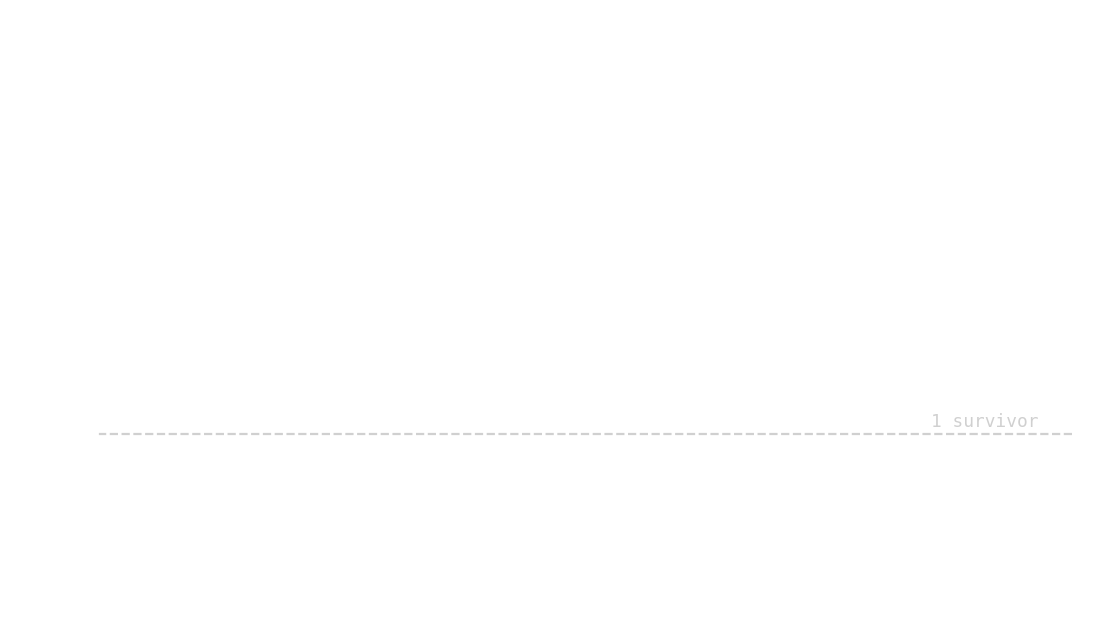
With one row, five structures leave about one wrong key out of 2^32.
Group 0
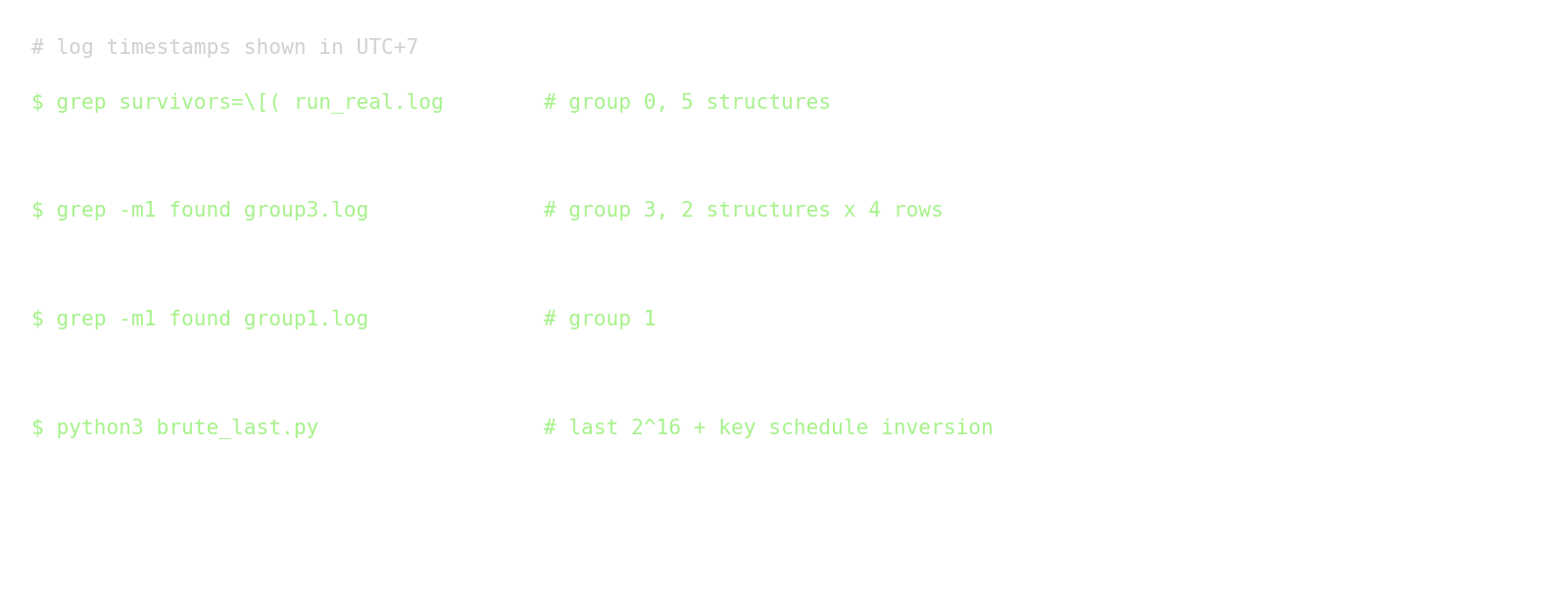
Five structures of group 0 and all 256 outer passes left exactly one candidate:
k6[0]=0x41 k6[13]=0x16 k6[10]=0x66 k6[7]=0x96 k5'(row 0)=0x2aIt held on the sixth structure and on all four rows, which also gives the whole of k5' and therefore k5 column 0: b9 ba bf 16.
Using the key schedule
Knowing a column of k5 links bytes of k6 through the AES-128 key schedule. With w20..w23 = k5 and w24..w27 = k6:
w24 = w20 ^ SubWord(RotWord(w23)) ^ Rcon(6)
w23 = w27 ^ w26
Row by row this gives relations such as k6[0] = w20[0] ^ S(k6[13] ^ k6[9]) ^ 0x20, which pins k6[9] = 0x3b straight away. The other rows tie k6[1], k6[2] and k6[3] to bytes we were about to search for.
Groups 3 and 1, under time pressure
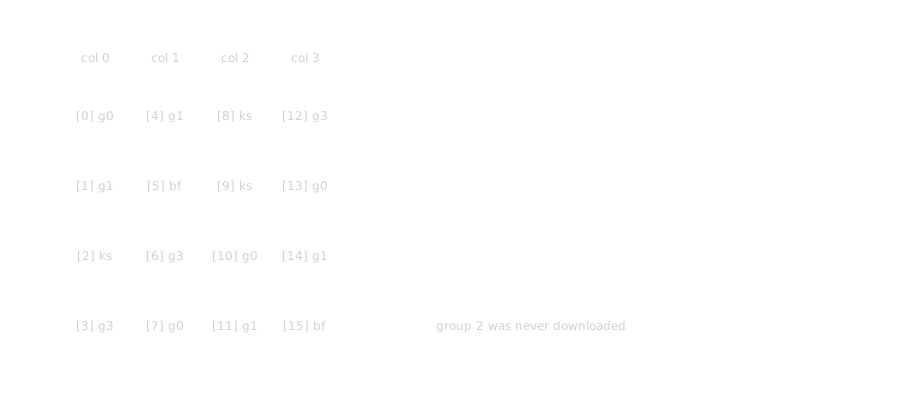
By the time the updated attachment was out there was not much time left, and the server delivered only about 1.8 MB/s. Downloading five 512 MiB files per group was not realistic, so only two structures per group were fetched. Two things made up for the weaker data:
- every candidate was tested on all four InvMixColumns rows at once (they share
k0..k3and each has its ownk5'byte), so a wrong key survives with probability about(256 * 2^-16)^4 = 2^-32; - the key-schedule relations cut the search space before the GPU even started.
The multi-row solver was checked again on group 0 with two structures, and it returned the same four bytes.
Group 3 was quick because k6[9] was already known. It gave k6[12]=0xd8, k6[6]=0x2c, k6[3]=0x80, and the row 3 relation then gave k6[8]=0xed. Group 1 gave k6[4]=0x5a, k6[1]=0x57, k6[14]=0x35, k6[11]=0xe5.
Group 2 never had to be downloaded. After group 1 only k6[5] and k6[15] were unknown, k6[2] follows from row 2, and 2^16 guesses checked against the known pair E(0) = 5d3d...6283 take a few seconds on a CPU.
Final Exploit
The heavy part is the GPU search (scripts/partial_sums_gpu.py and scripts/group_solve.py). Once the bytes above are known, the last step is short: brute-force the two missing bytes, invert the key schedule from k6, check E(0), and decrypt.
#!/usr/bin/env python3
import sys
from aes import AES6, crypt, SBOX, RCON

K6 = {0: 0x41, 13: 0x16, 10: 0x66, 7: 0x96, 9: 0x3b,
      12: 0xd8, 6: 0x2c, 3: 0x80, 8: 0xed,
      4: 0x5a, 1: 0x57, 14: 0x35, 11: 0xe5}
NONCE = bytes.fromhex('80e5faeca1828e3c')
FLAG_CT = bytes.fromhex('57e00d56e9822cbbdaaacadf94de6574cb141679a2995e1ec744c9668cdc9fcc94985718a3322587ba1ab69a8d76878798a9')
E0 = bytes.fromhex('5d3d1ede1baef0f9beb46d8ea6256283')

def master_from_k6(k6):
    w = [None] * 28
    for c in range(4):
        w[24 + c] = list(k6[4 * c:4 * c + 4])
    for i in range(27, 3, -1):
        t = w[i - 1][:]
        if i % 4 == 0:
            t = [SBOX[x] for x in t[1:] + t[:1]]
            t[0] ^= RCON[i // 4]
        w[i - 4] = [a ^ b for a, b in zip(w[i], t)]
    return bytes(sum(w[0:4], []))

for b15 in range(256):
    b2 = 0xbf ^ SBOX[b15 ^ K6[11]]
    for b5 in range(256):
        k6 = bytearray(16)
        for i, v in K6.items():
            k6[i] = v
        k6[15], k6[2], k6[5] = b15, b2, b5
        key = master_from_k6(bytes(k6))
        if AES6(key).encrypt_block(bytes(16)) == E0:
            print('key', key.hex(), 'k6', bytes(k6).hex())
            print(crypt(FLAG_CT, key, NONCE))
            sys.exit(0)
Output:
key aadfdc5eb4f7e79a2a8917e30f28d046 k6 41574d805a1d2c96ed3b66e5d81635e1
b'CSCV2026{sevenfold_aes7r_gpu_2_rtx_5090_hehe_hihi}'
Why This Works
2^32 plaintexts, one active diagonal
  ↓ 4 rounds of AES
every byte of s4 balanced (XOR = 0)
  ↓ server folds 2^32 ciphertexts into a parity bitmap
the XOR test only needs odd multiplicities
  ↓ partial sums, one key byte per stage, on the GPU
4 bytes of k6 + 1 byte of k5' per row
  ↓ groups 0, 3, 1 + key-schedule relations
13 bytes of k6, 2^16 left
  ↓ brute force against E(0), invert the key schedule
master key -> CTR keystream -> flag
The points that mattered:
- six-round AES is the textbook target of the Square attack, and the service hands out exactly the data that attack consumes;
- a parity bitmap is enough because the test is a GF(2) sum, so even multiplicities cancel;
- partial sums turn 2^71 into something a laptop GPU finishes in about a second per pass, once the data is handled as bit vectors;
- testing on a locally generated bitmap with a known key, before touching the server's data, caught bugs cheaply;
- relations from the AES key schedule are a free filter, and they made group 2 unnecessary.
Final Words
The flag jokes about solving with an RTX 5090. The real thing ran on a 4 GB laptop GPU, which is a good reminder that the bottleneck was never the hardware: the first kernel was eighty times slower than the second one on the same card.
The download speed near the end was the real enemy. Two structures per group plus four rows per test was a compromise forced by the clock, and it held up.
CSCV2026{sevenfold_aes7r_gpu_2_rtx_5090_hehe_hihi}